
Trust Under Pressure: How Digital Narratives Are Reshaping Financial Stability Perception
Financial systems remain stable, but how stability is interpreted has structurally shifted
Global Trust in Financial Institutions
Trust levels remain below historical highs despite improvements in system resilience.
Narrative Spread vs Institutional Response
Financial signals now travel significantly faster across digital platforms than formal responses.
Financial systems today continue to operate on strong structural foundations, supported by capital adequacy, liquidity buffers, and regulatory oversight. Across most major markets, these indicators remain stable and, in many cases, stronger than in previous cycles of financial stress.
At the same time, the way financial stability is interpreted has undergone a structural shift.
The movement of financial information has changed in both speed and structure. Signals that were previously contained within institutional, regulatory, or analyst environments now circulate across public platforms in real time.
Information reaches a broader and more diverse set of participants before it is fully contextualised, often moving across multiple channels simultaneously.
This has expanded the number of actors involved in interpreting financial signals.
Institutional investors, retail participants, analysts, media platforms and independent commentators now operate within the same information environment, but with different levels of access, context and interpretation frameworks.
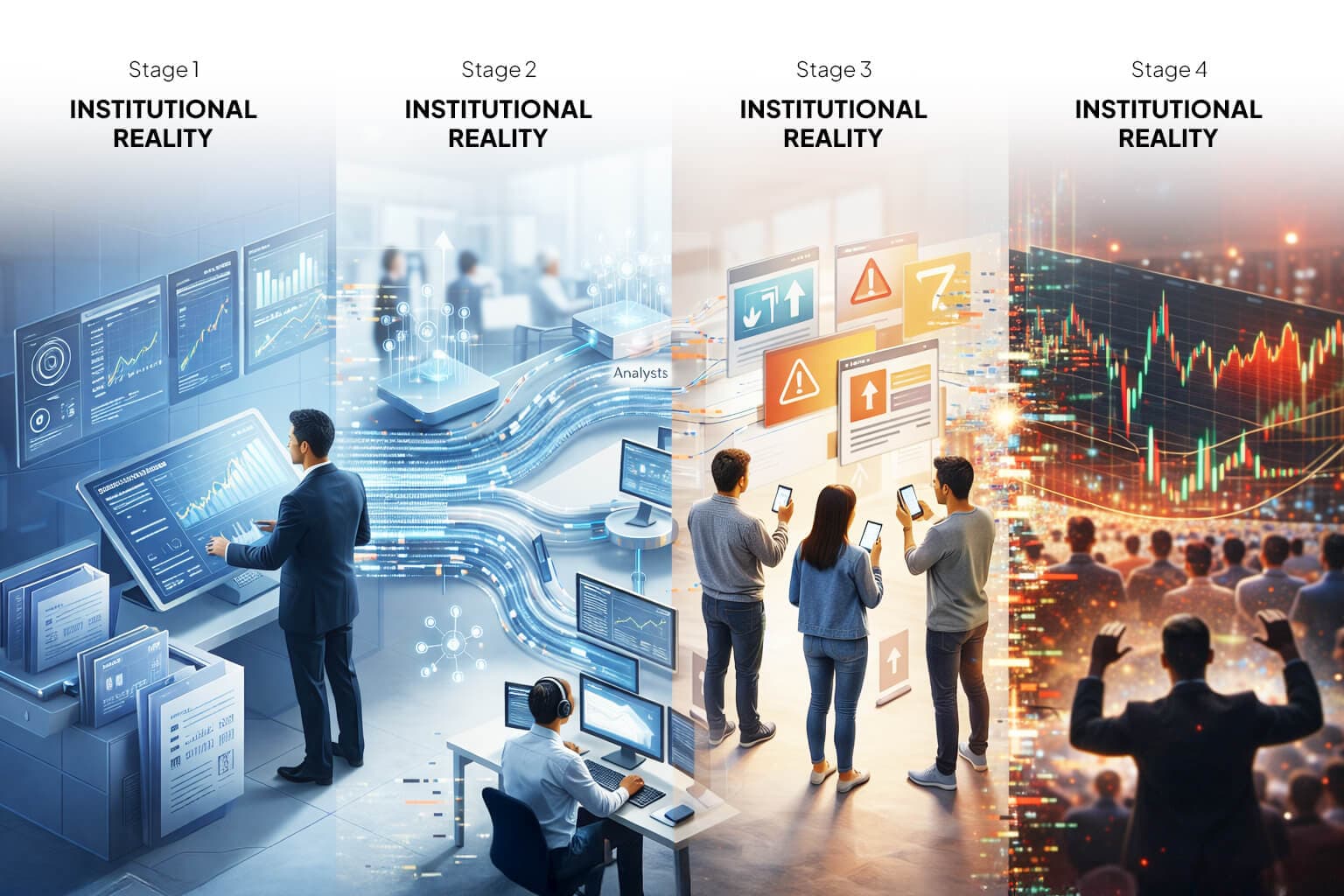
Institutional Reality
Signals originate from structured financial data and disclosures
Information Circulation
They are redistributed across media, analyst networks and digital platforms
Public Interpretation
Interpretation forms across audiences with varying levels of context
Market Behaviour
Market behaviour reflects aggregated perception rather than a single validated view
Institutional systems continue to operate on defined timelines, with communication designed around accuracy, verification and regulatory alignment. These systems assume that information will be interpreted within a structured context.
Digital environments operate differently. Information is prioritised for speed, accessibility and relevance. As signals move across these environments, they are often simplified, reframed or selectively amplified. The same data point can carry different meanings depending on how it is presented and where it is encountered.
This creates a layering effect in interpretation.
At the institutional level, stability is assessed through quantitative metrics and long-term indicators. At the market level, interpretation increasingly incorporates sentiment, behavioural signals and real-time information flows. At the public level, understanding is often shaped by condensed narratives that prioritise immediacy over completeness.
These layers do not operate independently. They interact continuously.
A regulatory update may be interpreted as routine within institutional frameworks, while being framed as a signal of systemic concern in public discourse. A short-term liquidity event may be assessed as contained within financial systems, but perceived as indicative of broader instability when amplified through digital channels.
Early signals, even when incomplete, can begin to influence sentiment before they are validated or contextualised.
Over time, this creates a divergence between system conditions and system perception, not because the underlying system has changed, but because the pathways through which it is understood have expanded.
This shift is further reinforced by the growing role of retail participation and distributed information sources. Market reactions are no longer driven solely by institutional interpretation. They reflect aggregated responses across multiple participant groups, each responding to different versions of the same signal.
Organizations often respond to this environment by increasing the frequency and volume of communication. Additional disclosures, updates and clarifications are introduced to provide context and reduce uncertainty.
However, volume does not necessarily translate into consistency. When communication is not aligned with how information travels and is interpreted across different environments, it can introduce further variation rather than reduce it.
A more stable interpretive environment tends to emerge where institutional signals, stakeholder engagement and broader information flows are aligned early.
This alignment does not depend on increasing communication, but on structuring it in a way that remains consistent across audiences and channels.
In such cases, interpretation remains closer to underlying conditions. Where alignment is weaker, perception can evolve independently and begin to influence behaviour across markets, even in the absence of material changes in fundamentals.
Sources
- Edelman — Trust Barometer (2024)
- International Monetary Fund — Digital Finance and Stability Reports (2024)
- Bank for International Settlements — Market Structure Analysis (2024)
- Reuters Institute — Digital News Report (2024)
Popular Insights
The Gap Between What Companies Say And What Markets Hear




News & Announcements


What The ECB’s Latest Digital Euro Push Could Mean For Trust And Stakeholder Confidence In Payments




Global Success Stories

Strategic Advocacy Outlook 2026
Strategic Influence, Institutional Trust and the Future of Advocacy

Asia Semiconductor Narrative 2026
Navigating Geopolitical Tensions in the Global Supply Chain

Operating in Real-Time Feedback Loops
The Evolution of Information Integrity and Open Influence Ecosystems
Strategic Advocacy Outlook 2026
Strategic Influence, Institutional Trust and the Future of Advocacy
Asia Semiconductor Narrative 2026
Navigating Geopolitical Tensions in the Global Supply Chain
Operating in Real-Time Feedback Loops
The Evolution of Information Integrity and Open Influence Ecosystems
Explore Industries

Energy, Resources & Circular Economy
Operating at the intersection of policy, capital and public scrutiny, where perception shapes access, alignment and long-term positioning.

Financial Services
Operating at the intersection of regulation, market perception and institutional trust, where capital flows are influenced as much by narrative interpretation as by financial performance.

Consumer & Digital Economy
Operating within fast-moving environments where perception, behaviour and platform dynamics directly influence growth, trust and regulatory response.

Defense & Strategic Industries
Operating within high-sensitivity environments where perception, compliance and institutional alignment determine long-term positioning and access.

Healthcare & Life Sciences
Operating across clinical complexity, regulatory oversight and public perception, where interpretation influences adoption, trust and treatment pathways.
Infrastructure & Transport
Operating across long-cycle investments, regulatory oversight and public acceptance, where project viability is shaped by multi-stakeholder interpretation.

Public Sector & Sovereign Institutions
Operating in environments where policy, perception and stakeholder interpretation directly influence national positioning, institutional credibility and international engagement.

Technology, Media & Platforms
Operating at the intersection of scale, regulation and public perception, where platform decisions, content ecosystems and policy scrutiny shape long-term positioning and market access.