
How Regulatory Reviews Start Quietly And Then Reshape Entire Narratives

Most regulatory reviews begin without noise. They sit within filings, complaints or routine oversight, often treated as part of normal business operations. Internally, they are understood as procedural. Externally, they are barely visible.
What changes is not the review itself, but how it begins to travel.
Across sectors like fintech, telecom and digital platforms, regulatory activity is constant. Frameworks are designed to evolve alongside innovation, which means reviews, clarifications and interventions are not unusual. Yet markets do not respond to process alone. They respond to signals.
The moment a review becomes visible, even in fragments, it starts to acquire meaning beyond its original context. Investors begin to interpret potential outcomes. Industry actors reposition themselves. Conversations emerge in parallel, often without coordination. In one recent instance, a fintech company saw its stock decline by nearly six percent following early reports of regulatory tightening, despite no confirmed action at the time.
| Signal Event | Observed Market Behaviour | Source Context |
|---|---|---|
| Early Regulatory News (Fintech) | ~6% Stock Movement Before Confirmed Action | Economic Times (2025) |
| Regulatory Perception Shifts | Direct Impact On Investor Confidence | IMF / KPMG Studies |
| ESG / Governance Concerns Emerging | Increased Media And Analyst Attention | Global Market Reports |
| Platform & Telecom Disputes | Rapid Narrative Amplification Across Digital Media | Industry Case Trends |
From there, the shift is gradual but decisive.
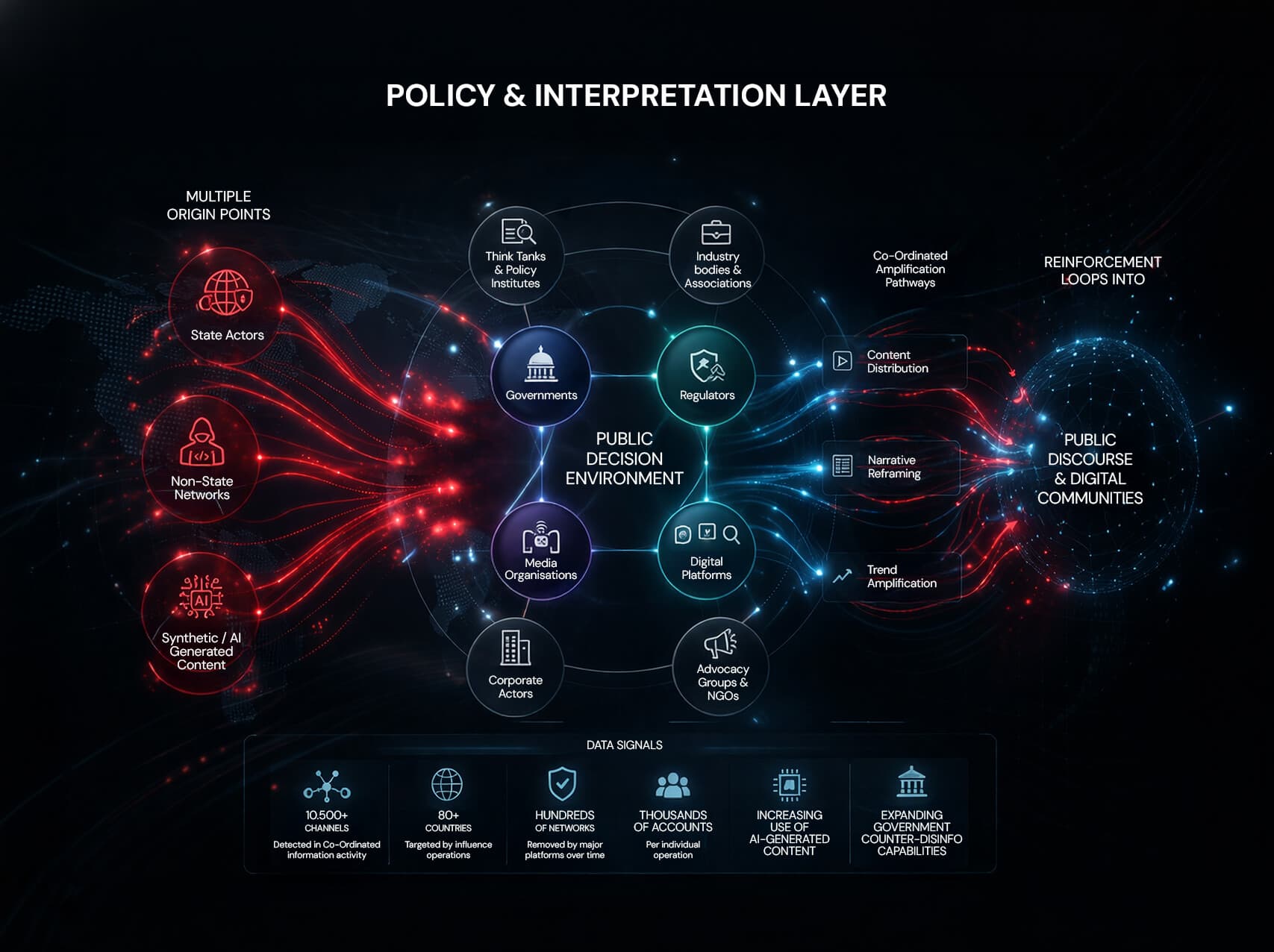
Commercial disagreements begin to take on regulatory language. Partner concerns are reframed as structural issues. Commentary starts to consolidate around simplified narratives that are easier to circulate than the underlying complexity. Digital platforms accelerate this process, amplifying selective interpretations and reinforcing early impressions.
At this stage, the review is no longer contained within an institutional process. It is being interpreted across multiple environments at once.
This is where asymmetry becomes visible. Formal processes move at one pace, while narratives evolve at another. In sectors where regulatory direction directly influences capital flows, this gap matters. Studies across financial markets continue to show that regulatory perception, not just regulatory action, plays a material role in shaping investor confidence and valuation movement.
What appears procedural internally can begin to influence positioning externally.
Organizations often assume that clarity will emerge through the process itself. In practice, outcomes are shaped across three overlapping layers: how institutions evaluate the issue, how markets interpret it and how narratives carry it forward. These layers do not operate independently. They reinforce each other, sometimes in ways that are difficult to reverse once established.
The difference between contained reviews and escalating situations is rarely the issue itself. It is how early the environment around it begins to form.
In situations that stabilise, there is usually a moment where credible reference points enter the conversation. Independent perspectives, structured engagement with industry and expert ecosystems, or a shift toward evidence-based framing begin to rebalance interpretation. Not through volume, but through placement.
Because once a review becomes a narrative, it no longer belongs to the process that created it.
It belongs to the systems interpreting it.
Sources
- IMF Fintech Risk and Market Studies (2025)
- KPMG Global Regulatory Outlook (2025)
- Financial Sector Deepening Trust Digital Finance Analysis (2024)
- Economic Times Market Response to Regulatory Signals (2025)
Popular Insights
The Gap Between What Companies Say And What Markets Hear






News & Announcements



What The ECB’s Latest Digital Euro Push Could Mean For Trust And Stakeholder Confidence In Payments




Global Success Stories

Strategic Advocacy Outlook 2026
Strategic Influence, Institutional Trust and the Future of Advocacy

Asia Semiconductor Narrative 2026
Navigating Geopolitical Tensions in the Global Supply Chain

Operating in Real-Time Feedback Loops
The Evolution of Information Integrity and Open Influence Ecosystems
Strategic Advocacy Outlook 2026
Strategic Influence, Institutional Trust and the Future of Advocacy
Asia Semiconductor Narrative 2026
Navigating Geopolitical Tensions in the Global Supply Chain
Operating in Real-Time Feedback Loops
The Evolution of Information Integrity and Open Influence Ecosystems
Explore Industries

Energy, Resources & Circular Economy
Operating at the intersection of policy, capital and public scrutiny, where perception shapes access, alignment and long-term positioning.

Financial Services
Operating at the intersection of regulation, market perception and institutional trust, where capital flows are influenced as much by narrative interpretation as by financial performance.

Consumer & Digital Economy
Operating within fast-moving environments where perception, behaviour and platform dynamics directly influence growth, trust and regulatory response.

Defense & Strategic Industries
Operating within high-sensitivity environments where perception, compliance and institutional alignment determine long-term positioning and access.

Healthcare & Life Sciences
Operating across clinical complexity, regulatory oversight and public perception, where interpretation influences adoption, trust and treatment pathways.
Infrastructure & Transport
Operating across long-cycle investments, regulatory oversight and public acceptance, where project viability is shaped by multi-stakeholder interpretation.

Public Sector & Sovereign Institutions
Operating in environments where policy, perception and stakeholder interpretation directly influence national positioning, institutional credibility and international engagement.

Technology, Media & Platforms
Operating at the intersection of scale, regulation and public perception, where platform decisions, content ecosystems and policy scrutiny shape long-term positioning and market access.