
The Gap Between What Companies Say And What Markets Hear
Communication does not travel intact. It evolves through interpretation across systems.

The Interpretation Gap Model
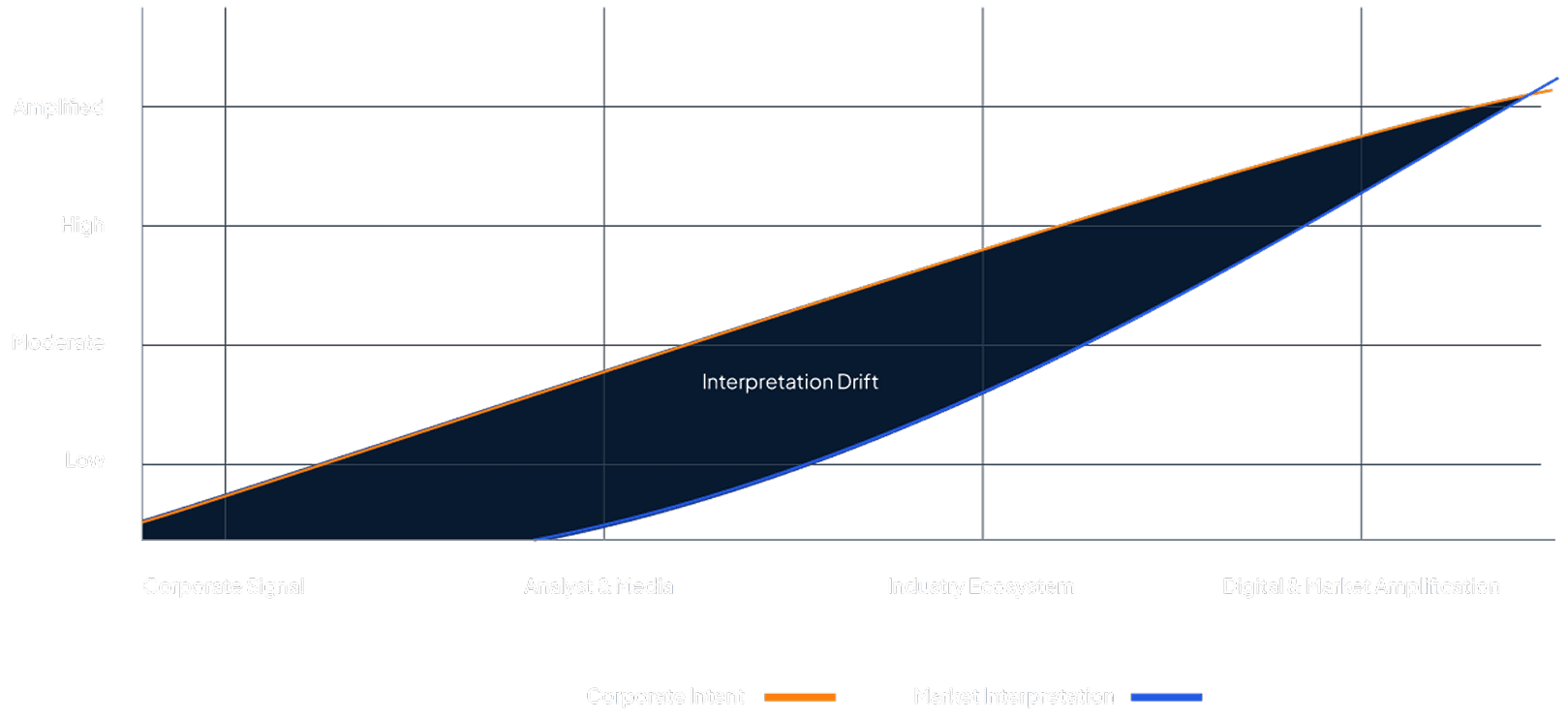
Early Stage
Message Remains Close To Original Intent
Mid Stage
Selective Framing Begins
Late Stage
Competitive And Narrative Positioning Takes Over
Final Stage
Amplified Interpretation Drives Market Response
Most organizations assume that what they communicate is what stakeholders understand.
In practice, communication does not travel intact.
It moves through layers of interpretation shaped by analysts, media, industry voices and digital ecosystems. By the time it reaches markets, it is rarely the same as what was originally said.
The gap is not always visible at the start. It appears gradually, often in small inconsistencies. A message lands differently across regions. Investor questions begin to shift in tone. Media coverage simplifies what was intended to be nuanced. None of these signals are definitive on their own, but together they indicate divergence.
What companies say begins to separate from what markets hear.
This is not a failure of communication in the traditional sense. It is a function of how information now moves. Corporate messaging is structured, deliberate and internally aligned. Market interpretation is external, layered and influenced by competing signals.
In environments where multiple stakeholders are involved, consistency becomes difficult to maintain.
As communication moves outward, the first layer of interpretation begins with analysts and media. Attention shifts toward signals of risk, performance or comparison. Nuance is reduced to emphasis.
The next layer introduces industry context. Competitors, partners and ecosystem players reinterpret the message relative to their own positioning. What was intended as neutral or positive may begin to shift in meaning.
Digital platforms accelerate this process further. Fragments of the message circulate independently, often detached from their original context. What remains is not the full communication, but a version shaped by speed, visibility and repetition.
Across markets, this drift is not theoretical. Early-stage narrative signals have been observed to move valuations before formal outcomes are confirmed. In one instance, regulatory reporting alone triggered a near six percent shift in stock value, reflecting interpretation rather than decision.
From this point, the gap begins to develop its own momentum.
Once interpretation starts to move independently, it becomes harder to realign. Investors begin to anchor to perceived risk. Media narratives stabilise around simplified frames. Industry conversations reinforce emerging positions. Each layer builds on the previous one, often without returning to the original source.
Part of the challenge lies in how differently each ecosystem processes information. Investors look for signals that affect valuation. Industry participants interpret competitive positioning. Media seeks clarity and narrative direction. Digital systems amplify what is most visible, not necessarily what is most accurate.
Individually, these shifts appear manageable. Collectively, they create distance.
Organizations often respond by increasing communication. More statements, more clarification, more engagement. Yet volume rarely closes the gap. In some cases, it widens it further, introducing new variations into an already fragmented environment.
What changes the trajectory is not frequency, but alignment.
In situations where the gap narrows, communication is supported by external validation, consistent stakeholder engagement and credible reference points that travel across systems. Independent reports, expert voices and structured engagement begin to stabilise interpretation. Not by correcting every version, but by establishing one that others align to.
Because markets do not respond to communication alone.
They respond to how that communication is interpreted across systems.
And once that interpretation diverges,
it rarely corrects itself.
Sources
- IMF Market Signalling and Financial Stability Studies (2025)
- KPMG Global CEO Outlook and Regulatory Insights (2025)
- Global Market Behaviour and ESG Perception Reports (2024–2025)
- Economic Times Market Reaction to Regulatory Signals (2025)
Popular Insights




News & Announcements


What The ECB’s Latest Digital Euro Push Could Mean For Trust And Stakeholder Confidence In Payments



Global Success Stories

Strategic Advocacy Outlook 2026
Strategic Influence, Institutional Trust and the Future of Advocacy

Asia Semiconductor Narrative 2026
Navigating Geopolitical Tensions in the Global Supply Chain

Operating in Real-Time Feedback Loops
The Evolution of Information Integrity and Open Influence Ecosystems
Strategic Advocacy Outlook 2026
Strategic Influence, Institutional Trust and the Future of Advocacy
Asia Semiconductor Narrative 2026
Navigating Geopolitical Tensions in the Global Supply Chain
Operating in Real-Time Feedback Loops
The Evolution of Information Integrity and Open Influence Ecosystems
Explore Industries

Energy, Resources & Circular Economy
Operating at the intersection of policy, capital and public scrutiny, where perception shapes access, alignment and long-term positioning.

Financial Services
Operating at the intersection of regulation, market perception and institutional trust, where capital flows are influenced as much by narrative interpretation as by financial performance.

Consumer & Digital Economy
Operating within fast-moving environments where perception, behaviour and platform dynamics directly influence growth, trust and regulatory response.

Defense & Strategic Industries
Operating within high-sensitivity environments where perception, compliance and institutional alignment determine long-term positioning and access.

Healthcare & Life Sciences
Operating across clinical complexity, regulatory oversight and public perception, where interpretation influences adoption, trust and treatment pathways.
Infrastructure & Transport
Operating across long-cycle investments, regulatory oversight and public acceptance, where project viability is shaped by multi-stakeholder interpretation.

Public Sector & Sovereign Institutions
Operating in environments where policy, perception and stakeholder interpretation directly influence national positioning, institutional credibility and international engagement.

Technology, Media & Platforms
Operating at the intersection of scale, regulation and public perception, where platform decisions, content ecosystems and policy scrutiny shape long-term positioning and market access.