
Infrastructure Is Now Geopolitics: Why Projects Face Narrative Risk Before Execution Risk
Risk is emerging earlier, shaped by interpretation before execution
Global Infrastructure Requirement by 2040
Demand for infrastructure investment continues to scale across transport, energy and urban systems.
Projects Facing Delays or Disputes
A significant share of large infrastructure projects experience delays linked to non-technical factors.
Large infrastructure projects were traditionally evaluated through technical feasibility, financing structures and execution timelines. These factors continue to determine delivery. What has changed is when risk begins to emerge.
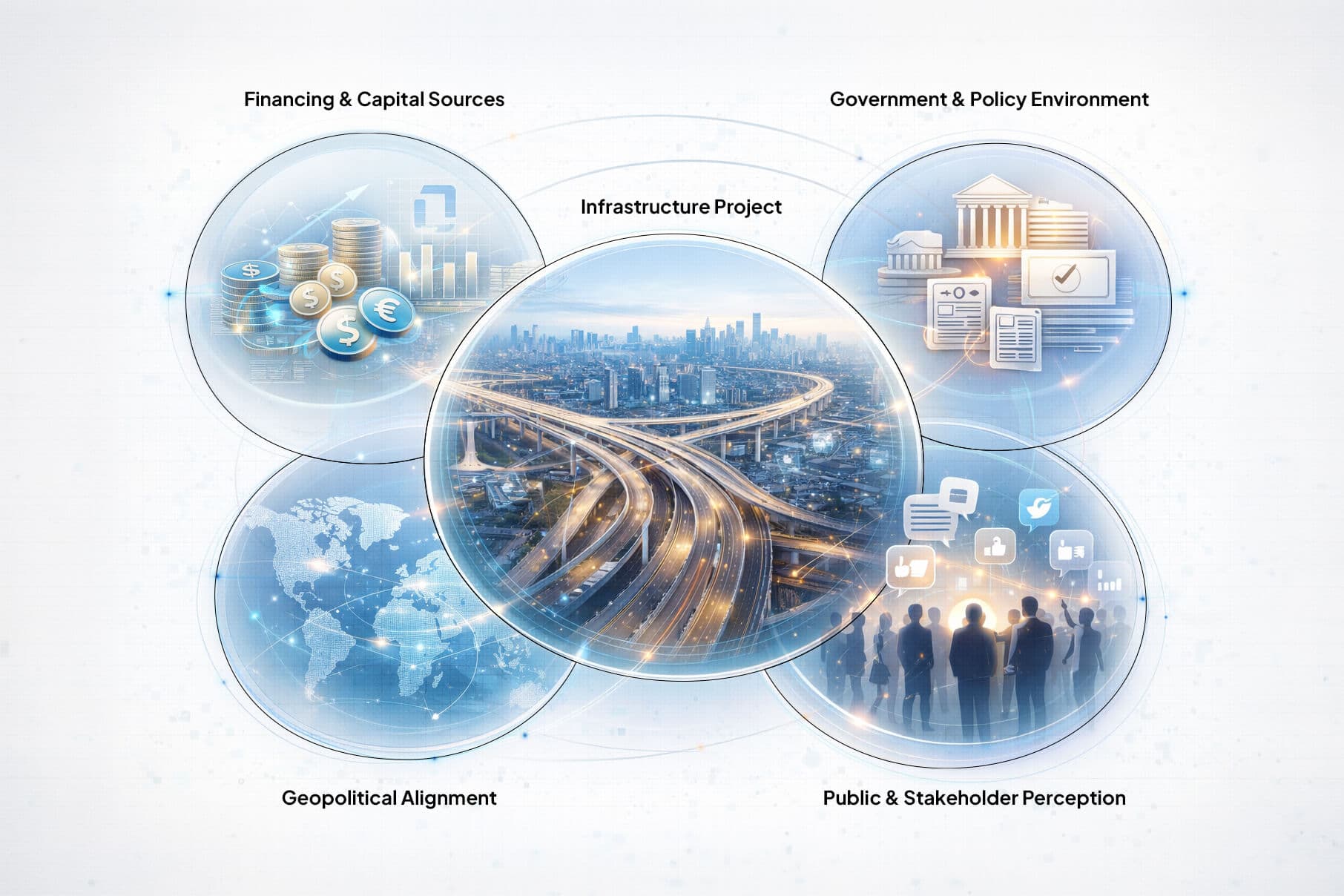
Infrastructure is increasingly situated within geopolitical and policy environments that extend beyond the project itself. Financing sources, ownership structures, cross-border partnerships and strategic alignment with national priorities are now part of how projects are assessed.
As a result, interpretation begins earlier.
Projects that were previously evaluated within technical and commercial frameworks are now examined through additional lenses. These include national interest, economic dependency, environmental impact and long-term strategic influence. The same project can carry different implications depending on who is evaluating it and in what context.
The shift is not in the existence of risk, but in its sequencing.
Technical and execution risks remain, but they are increasingly preceded by narrative formation. Stakeholders begin to interpret the project before construction progresses, sometimes even before final approvals are in place.
Public discourse, policy debate and institutional positioning contribute to how the project is understood. In some cases, this interpretation becomes more influential than the underlying technical plan.
A project financed through international partnerships may be viewed as economic development in one context and strategic dependency in another. Environmental considerations may be assessed as compliance requirements within regulatory frameworks, while being framed as broader sustainability concerns in public discourse. Commercial agreements can be interpreted as routine within industry contexts, while being positioned as structural risks in political or media environments.
These interpretations do not remain isolated. They interact across systems.
Governments assess alignment with national priorities and policy direction. Investors evaluate exposure to regulatory and geopolitical risk. Industry participants position themselves relative to evolving narratives. Media and public platforms amplify certain aspects of the project based on relevance and accessibility.
As these layers converge, the project is no longer defined only by its design and execution. It is defined by how it is understood across these environments.
Organizations often respond to emerging concerns at later stages, once delays or disputes become visible. By that point, interpretation may already be established across stakeholders, making repositioning more complex.
Where projects progress more smoothly, there is earlier alignment between technical planning, policy positioning and stakeholder engagement. The narrative around the project develops alongside the project itself, rather than forming independently of it.
In such cases, interpretation remains closer to intended positioning. Where alignment is weaker, narrative can evolve separately and begin to influence decision-making, timelines and stakeholder confidence before execution risk becomes material.
Infrastructure development continues to depend on engineering, financing and delivery capability. Increasingly, it also depends on how consistently the project is understood across the environments in which it operates.
Sources
- Global Infrastructure Outlook (2024)
- World Bank — Infrastructure and Development Reports (2024)
Popular Insights
The Gap Between What Companies Say And What Markets Hear




News & Announcements



What The ECB’s Latest Digital Euro Push Could Mean For Trust And Stakeholder Confidence In Payments




Global Success Stories

Strategic Advocacy Outlook 2026
Strategic Influence, Institutional Trust and the Future of Advocacy

Asia Semiconductor Narrative 2026
Navigating Geopolitical Tensions in the Global Supply Chain

Operating in Real-Time Feedback Loops
The Evolution of Information Integrity and Open Influence Ecosystems
Strategic Advocacy Outlook 2026
Strategic Influence, Institutional Trust and the Future of Advocacy
Asia Semiconductor Narrative 2026
Navigating Geopolitical Tensions in the Global Supply Chain
Operating in Real-Time Feedback Loops
The Evolution of Information Integrity and Open Influence Ecosystems
Explore Industries

Energy, Resources & Circular Economy
Operating at the intersection of policy, capital and public scrutiny, where perception shapes access, alignment and long-term positioning.

Financial Services
Operating at the intersection of regulation, market perception and institutional trust, where capital flows are influenced as much by narrative interpretation as by financial performance.

Consumer & Digital Economy
Operating within fast-moving environments where perception, behaviour and platform dynamics directly influence growth, trust and regulatory response.

Defense & Strategic Industries
Operating within high-sensitivity environments where perception, compliance and institutional alignment determine long-term positioning and access.

Healthcare & Life Sciences
Operating across clinical complexity, regulatory oversight and public perception, where interpretation influences adoption, trust and treatment pathways.
Infrastructure & Transport
Operating across long-cycle investments, regulatory oversight and public acceptance, where project viability is shaped by multi-stakeholder interpretation.

Public Sector & Sovereign Institutions
Operating in environments where policy, perception and stakeholder interpretation directly influence national positioning, institutional credibility and international engagement.

Technology, Media & Platforms
Operating at the intersection of scale, regulation and public perception, where platform decisions, content ecosystems and policy scrutiny shape long-term positioning and market access.